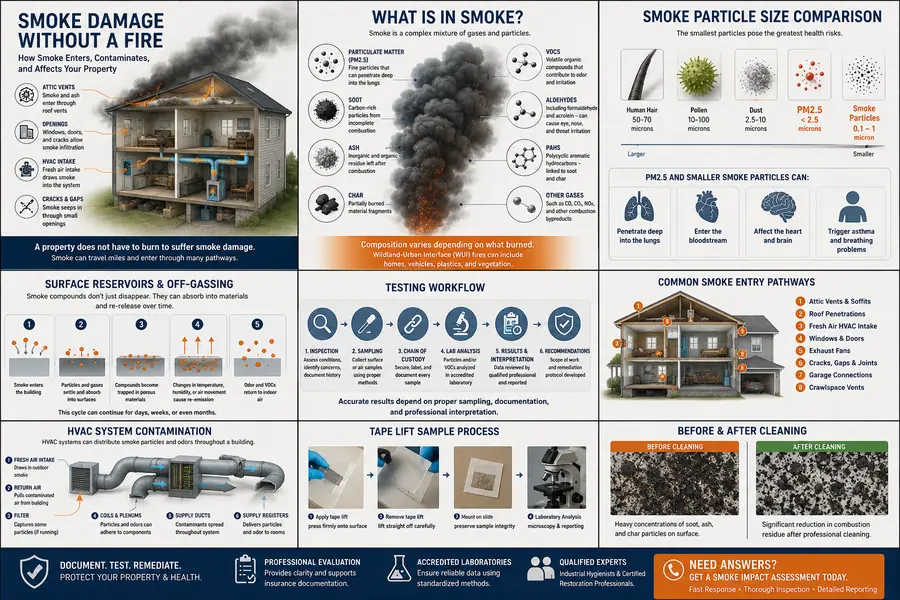
1. What "smoke damage without a fire" means
"Smoke damage without a fire" refers to smoke-related impact to a property that was not itself burned by flames. The structure may remain standing, intact, and visually normal while still being affected by smoke intrusion, ash fallout, odor absorption, surface deposition, or HVAC contamination. Common examples:
- A home near a wildfire where smoke entered through attic vents, HVAC systems, or gaps in the building envelope.
- A condo or apartment affected by smoke from a fire in another unit, corridor, or common area.
- A commercial building exposed to smoke from a neighboring structure fire.
- A property downwind from a wildfire plume that later smells smoky even though no flames touched the parcel.
- A home where ash accumulated outside and later entered through doors, windows, shoes, pets, vents, or HVAC operation.
- A business where smoke odor recurs after cleaning because odor-causing compounds remain in porous materials or surface films.
People associate "fire damage" with visible charring or direct flame contact. Smoke damage is broader: deposited residues, indoor air contamination, odor chemistry, surface reservoirs, and building-system contamination. The National Academies' report on wildland-urban interface fires shows that modern wildfire smoke is not just vegetation smoke — homes, cars, plastics, wiring, and consumer products may burn together, creating complex emissions and residues.[4]
2. How smoke enters a building that did not burn
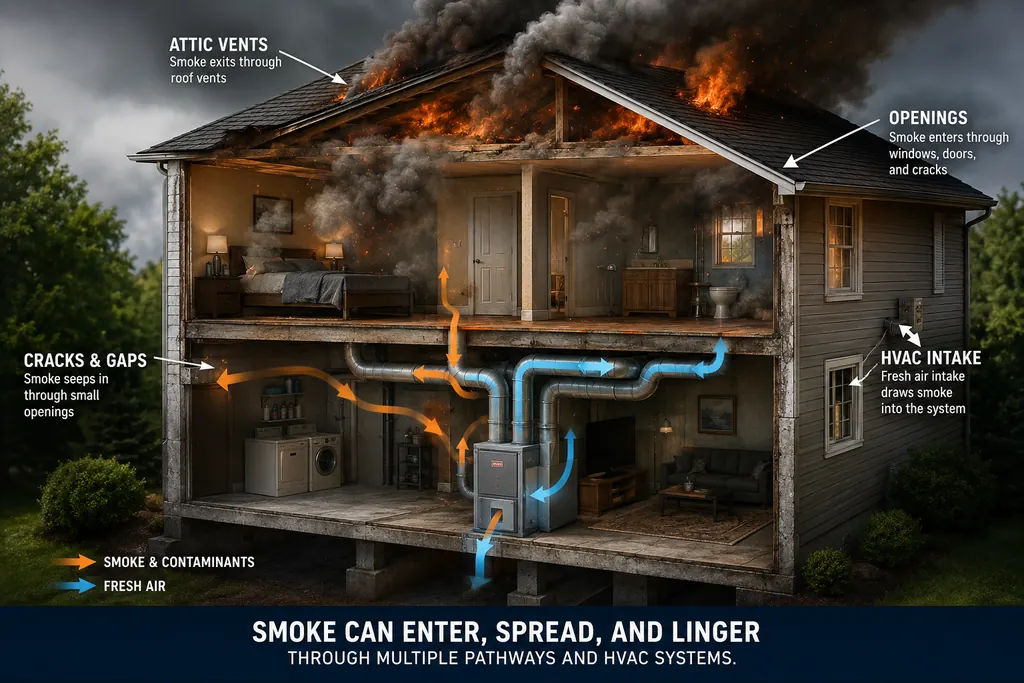
Smoke intrusion is a building-science problem. No structure is airtight — even new buildings exchange air with the outdoors through designed and undesigned pathways. The EPA identifies three major smoke-entry mechanisms:[1]
2.1 Natural ventilation
The simplest route. If windows, doors, garage doors, pet doors, or vents are open while outdoor smoke is present, smoke moves indoors rapidly. Even brief exposure can create odor and surface deposition when smoke density is high.
2.2 Mechanical ventilation
HVAC fresh-air intakes, economizers, make-up-air systems, bathroom and kitchen exhaust fans, and whole-house ventilation can pull smoky outdoor air in. In commercial and multifamily buildings this is a major pathway, because those systems are designed to move large volumes of air — and once smoke passes through an HVAC system, it distributes particles and odor compounds far beyond the room facing the smoke source.
2.3 Infiltration
Infiltration occurs even when occupants believe the building was "closed up" — through cracks, sill plates, wall and plumbing penetrations, recessed lighting, attic hatches, rim joists, crawlspace openings, window frames, and weatherstripping. A closed door is not a laboratory seal. A closed window is not a gas-tight barrier.
2.4 Pressure differences
Wind, stack effect, exhaust fans, and temperature differences create pressure gradients that pull smoke inward. Buildings under negative pressure relative to outdoors — common in commercial buildings with large exhaust loads — are especially vulnerable.
2.5 Attics, crawlspaces, and hidden cavities
Attics and crawlspaces are connected to the outdoors by design and often contain porous materials. Smoke or ash entering an attic settles on insulation, framing, stored contents, and ductwork. Occupants may not see it — but odor recurs when temperatures rise, HVAC systems run, or air moves through the building.
3. What smoke contains
Smoke is not a single substance. It is a changing mixture of particles, gases, vapors, and combustion byproducts whose composition depends on fuel type, oxygen availability, temperature, duration, weather, distance, and whether the fire involved vegetation, structures, vehicles, plastics, or industrial materials. The EPA describes wildfire smoke as a complex mixture that can include carbon monoxide, nitrogen oxides, organic compounds, VOCs, PAHs, and particulate matter,[2] and identifies benzene, formaldehyde, acrolein, and PAHs among toxic pollutants in wood smoke.[5] For property damage, the most important components are usually:
| Component | Property relevance |
|---|---|
| PM2.5 fine particles | Penetrate deep indoors and deep into lungs; primary health driver |
| Soot | Carbonaceous residue of incomplete combustion; deposits on surfaces |
| Ash & char | Fallout residue and burned-material fragments; markers of intrusion |
| VOCs & SVOCs | Partition between air, dust, and surfaces; drive persistent odor |
| PAHs | Combustion-related compounds; ATSDR notes they occur in mixtures such as soot[7] |
| Aldehydes & phenolics | Formaldehyde, acrolein, cresols, guaiacol-type compounds — wood-smoke chemical signatures |
4. Why wildland-urban interface fires are different
WUI fires occur where development overlaps wildland vegetation. Smoke may come from burning trees and grasses — but also from homes, garages, cars, plastics, electronics, furniture, treated lumber, insulation, roofing, stored chemicals, and batteries. The National Academies explains that the interaction of these sources can create public-health effects unique to WUI fires.[4]
Practically, this means post-wildfire investigation should not assume a simple, uniform contaminant profile. A sampling plan may need to consider vegetation smoke, structure-fire smoke, synthetic-material combustion byproducts, ash fallout, HVAC pathways, porous-material absorption, background contamination, proximity and wind direction, and time elapsed since exposure.
5. Visible smoke damage vs. hidden smoke damage
Visible indicators include gray or black residue, ash on windowsills, staining around vents, darkened HVAC filters, oily films, soot tracking near air pathways, and ash in attic spaces. Visible evidence is useful — but absence of visible evidence does not prove absence of smoke impact.
Odor is often the first sign, but it is not a complete diagnostic: weak odor does not rule out residue, some contaminants remain without strong odor, and odor can persist after airborne particles decline because odor-active compounds remain in materials.
Hidden reservoirs include attic insulation, wall cavities, crawlspaces, carpet backing, upholstery, drapes, unfinished wood, dust reservoirs, duct interiors, evaporator coils, filters, and return plenums. FEMA's residential smoke-damage guidance notes that soot and ash can damage porous materials such as upholstery and clothing, sometimes beyond practical cleaning, and can contribute to health impacts if not removed properly.[8]
6. Why smoke odor can come back after cleaning
The reason is chemical persistence. Smoke compounds deposit onto surfaces, absorb into porous materials, and later re-enter indoor air — partitioning, sorption, desorption, and off-gassing. A NIST-associated Science Advances study introduced smoke into a test house and found that many smoke VOCs persisted for days, that ventilation played a limited role for some compounds because surface reservoirs mattered, and that surface cleaning (vacuuming, mopping, dusting) reduced indoor smoke VOCs more effectively and more persistently than portable air cleaners or open windows.[9] Colorado State University's summary puts it plainly: smoke gases can remain in floors and walls, and removal is not as simple as opening a window or running an air purifier.[10]
That is why smoke odor may return when humidity rises, temperature increases, HVAC systems run, porous materials warm up, surface films are disturbed, or contaminated dust is resuspended. The right question is not "Did the smell go away today?" — it is:
7. Health and indoor air concerns
The CDC states that wildfire smoke can cause coughing, trouble breathing, wheezing, asthma attacks, stinging eyes, scratchy throat, headaches, chest pain, and fast heartbeat.[11] The EPA emphasizes PM2.5 because fine particles can be inhaled deeply into the lungs.[12] People at increased risk include children, older adults, pregnant people, and those with asthma, COPD, or cardiovascular disease.[13]
Property owners should avoid turning health guidance into unsupported claims. A smoke-impacted property is not automatically "toxic" in a scientifically precise sense. The stronger, evidence-based position: smoke contains particles and chemicals that can affect indoor air and surfaces — if smoke entered a property, professional evaluation and testing may be appropriate to determine whether smoke-related residues are present and whether mitigation is needed.
8. Why "no flames" does not mean "no insurance issue"
Coverage depends on the policy, state law, facts, documentation, exclusions, and carrier investigation. But the NAIC states that homeowners and renters policies typically cover wildfire damage from smoke, soot, and ash, subject to policy terms and claim facts.[14] Disputes usually arise when the carrier treats the property as undamaged because the structure did not burn, soot is not visually obvious, the smoke source was off-site, cleaning was attempted before documentation, or the owner cannot prove smoke intrusion.
That is why documentation matters. A strong file may include: date and time of exposure, fire name or incident number, wind direction, evacuation-zone maps, AirNow/AQI history,[15] photos of ash and HVAC filters, odor logs, HVAC operation records, laboratory sampling results, industrial hygienist observations, chain-of-custody records, and carrier communications. The file should not rest on emotion or "it feels contaminated" — it should be an evidence packet.
9. Why visual inspection alone is often inadequate
Visual inspection can identify obvious soot, ash, staining, filter loading, and affected rooms. It may miss trace residues, microscopic soot, residues on dark surfaces, contamination inside HVAC systems, attic or crawlspace contamination, VOC reservoirs, and background-vs-event differences. Professional smoke evaluation therefore combines site history, building inspection, exposure reconstruction, HVAC assessment, surface and air sampling where appropriate, laboratory analysis, background comparison, and expert interpretation.
ANSI/IICRC S700 describes professional procedures for assessing the presence, intensity, and boundaries of fire residues and odors affecting buildings, building systems such as HVAC, and contents.[16] A legitimate smoke-mitigation process is not "spray deodorizer and leave" — it is assessment, boundary definition, scope development, remediation, and verification.
10. Testing for smoke damage without a fire
Testing should answer specific questions, not be random: Are smoke-related residues present? Where? Are they consistent with the reported event? Above background? Are HVAC systems or porous materials affected? What scope of cleaning or clearance verification is appropriate?
10.1 Smoke particle testing
Surface samples — tape lift, wipe, swab, dust, or micro-vacuum, depending on the surface and lab method — are collected from windowsills, countertops, HVAC registers and filters, attic surfaces, insulation, contents, and control/background areas, then analyzed for soot, char, ash, and other combustion particles.
10.2 Surface sampling
Smoke residue deposits onto surfaces rather than remaining airborne indefinitely. NIOSH guidance explains that standardized sampling and analysis allow reliable comparisons across locations, times, surfaces, and investigators;[17] OSHA recognizes surface wipe sampling for assessing contaminants that may contribute to exposure.[18]
10.3 VOC testing
Relevant when odor, chemical irritation, or smoke-gas persistence is part of the concern. EPA's Compendium of Methods provides peer-reviewed standardized methods for toxic organic pollutants in air,[19] notably TO-15A (canister sampling with GC-MS analysis)[20] and TO-17 (sorbent tubes with thermal desorption).[21] Design matters: one non-detect air sample does not prove no smoke compounds remain in surfaces or porous materials — timing, ventilation, temperature, sample duration, reporting limits, and comparison conditions all matter.
10.4 Background and comparison samples
Buildings contain cooking residues, candle soot, fireplace particles, and ordinary dust. A credible investigation distinguishes likely fire-related residues from normal background using unaffected areas, exterior surfaces, pre- vs. post-cleaning areas, or similar unexposed buildings.
10.5 Chain of custody
The documentation trail showing who collected each sample, when, where, how it was handled, and which laboratory received it. Carriers, attorneys, and labs need confidence that samples were not mislabeled or casually handled. A strong packet includes sample IDs and locations, collection methods, photos, field notes, custody transfer records, lab methods, detection/reporting limits, results, interpretation, and limitations.
11. HVAC smoke contamination
HVAC systems are often the difference between a small intrusion and a building-wide impact. If the system ran during a smoke event, it may have pulled smoke into return air, filters, ducts, coils, and occupied rooms — and it can re-distribute particles after the outdoor event has ended. EPA explicitly identifies HVAC fresh-air intakes as a smoke-entry route;[1] IICRC S700 recognizes that fire residues and odors can affect building systems including HVAC.[16]
HVAC documentation should include: photos of filters and their MERV rating, whether the system was running during exposure, whether fresh-air intake was open, duct locations and attic/crawlspace exposure, odor conditions during operation, and whether filters were replaced before inspection.
12. What property owners should do after smoke exposure
13. What not to do
- Don't assume "no visible soot" means "no smoke damage." Microscopic particles and VOCs may not be visible; odor reservoirs persist in porous materials.
- Don't rely only on air purifiers. They reduce airborne particles while operating, but do not clean surfaces, HVAC systems, or VOC reservoirs.[9]
- Don't clean everything before documentation. Undocumented cleaning removes evidence before inspection. Photograph first.
- Don't accept a purely visual denial without questioning its basis — especially when the dispute concerns microscopic residue, HVAC contamination, attic intrusion, or VOC persistence.
- Don't let contractors overstate certainty. Not every smoky smell proves a covered loss; not every house near a wildfire needs full remediation. The credible standard is evidence: exposure history, inspection, sampling where appropriate, lab interpretation, documented scope.
14. When professional testing is most justified
Testing is most justified when one or more of the following are true:
Testing does not replace professional judgment. It strengthens it.
15. Insurance documentation: the strong file
Build the claim file like an evidence record, in four layers: exposure evidence (fire incident name, official fire map, distance, wind direction, plume imagery, AQI data, evacuation alerts); property evidence (photos of ash, residue, and filters; odor log; HVAC status; visible entry pathways; cleaning history); technical evidence (inspection report, sampling plan, chain of custody, lab reports, interpretation, remediation recommendations, clearance plan); and claim evidence (policy, claim number, adjuster communications, estimates, denials, expert reports, invoices).
Frequently asked questions
Sources
- U.S. EPA. Wildfires and Indoor Air Quality (IAQ). Smoke entry via natural ventilation, mechanical ventilation/HVAC intakes, and infiltration through openings, joints, and cracks.
- U.S. EPA. Wildfire Smoke — A Complex Mixture. Gases, organic compounds, VOCs, PAHs, and particulate matter.
- CDC. Wildfire Smoke Exposure Poses Threat to At-Risk Populations (HAN advisory). Smoke as a mix of gases and fine particles from burning trees, plants, buildings, and other materials.
- National Academies of Sciences, Engineering, and Medicine. The Chemistry of Fires at the Wildland-Urban Interface.
- U.S. EPA. Wood Smoke and Your Health. Benzene, formaldehyde, acrolein, and PAHs among toxic pollutants in wood smoke.
- CDC/NIOSH. Wildland Fire Smoke. Carbon monoxide, hydrocarbons, particulate matter, benzene, acrolein, and aldehydes.
- ATSDR. Polycyclic Aromatic Hydrocarbons (PAHs) Toxicological Profile. PAHs form during incomplete burning and occur in mixtures such as soot.
- FEMA. Homeowner's Guide to Risk Reduction and Remediation of Residential Smoke Damage (Marshall Fire MAT, 2025).
- NIST / Science Advances. The persistence of smoke VOCs indoors: partitioning, surface cleaning, and air cleaning in a smoke-contaminated house.
- Colorado State University. Wildfire smoke leaves harmful gases in floors and walls.
- CDC. How Wildfire Smoke Affects Your Body.
- U.S. EPA. Wildfire Smoke — A Complex Mixture (PM2.5 health focus).
- CDC. HAN advisory — at-risk groups and exposure-reduction strategies.
- NAIC. What Should I Do After a Wildfire? Homeowners and renters policies typically cover wildfire damage from smoke, soot, and ash.
- AirNow Fire and Smoke Map (EPA / U.S. Forest Service). PM2.5 from wildfires and other sources.
- IICRC. ANSI/IICRC S700-2025 Standard for Professional Fire and Smoke Damage Restoration.
- NIOSH. Surface Sampling Guidance, Considerations, and Methods in Occupational Hygiene.
- OSHA. Surface Contamination — Evaluating Exposure.
- U.S. EPA. Compendium of Methods for the Determination of Toxic Organic Compounds in Ambient Air.
- U.S. EPA. Method TO-15A — VOCs in canisters, GC-MS analysis.
- U.S. EPA. Method TO-17 — VOCs on sorbent tubes, thermal desorption.